
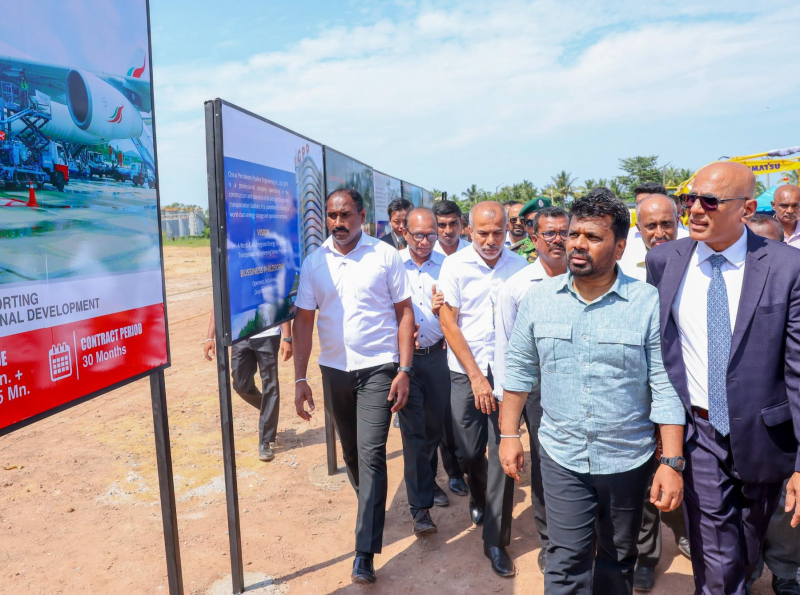
President Anura Kumara Dissanayake said that the Government’s objective is to maintain a strong state presence in the energy market while providing an efficient service to the people, adding that significant progress has been achieved towards this objective over the past two years and that a strong energy market that does not place a burden on the people is now being built in Sri Lanka.
The President made these remarks this morning (02) while attending the commencement of construction of the Jet A-1 pipeline system of the Ceylon Petroleum Corporation (CPC) and two new oil storage tank systems belonging to the CPC and the Ceylon Petroleum Storage Terminal Limited (CPSTL).
The projects are being implemented in line with the Government’s national objective of developing infrastructure in the energy sector, with the aim of ensuring the security of aviation fuel supplies, reducing supply costs and providing the capacity required to meet future demand for aviation fuel.
A dedicated pipeline and associated tank complex are being constructed to connect Muthurajawela with Bandaranaike International Airport in Katunayake, with the aim of meeting the future demand of the country’s aviation sector, ensuring the security of aviation fuel supplies and reducing transportation costs.
Construction has commenced on five new Jet A-1 fuel storage tanks with a total capacity of 92,000 cubic metres. These comprise two large Jet A-1 tanks, each with a capacity of 30,000 cubic metres; two medium-sized tanks, each with a capacity of 15,000 cubic metres; and an additional tank with a capacity of 2,000 cubic metres. The fuel supply pipeline system will be connected to the airport through a 21-kilometre-long underground pipeline with a diameter of 10 inches from the Muthurajawela tank complex. The project is scheduled for completion within 30 months.
Meanwhile, as part of ongoing efforts to strengthen and expand storage and infrastructure facilities in the petroleum industry, the Ceylon Petroleum Storage Terminal Limited (CPSTL) commenced construction today of three new storage tanks at the Muthurajawela Terminal.
Upon completion, the three-tank system, comprising two tanks with a capacity of 15,000 cubic metres each and one tank with a capacity of 10,000 cubic metres, will provide an additional total storage capacity of 40,000 cubic metres.
This will further enhance the petroleum storage capacity of the terminal and support the continued development of the country’s petroleum infrastructure. The project has a contractual period of 18 months and is scheduled for completion in April 2028.
The tanks are being constructed in compliance with relevant international standards and recognised industry best practices, ensuring enhanced safety, reliability and operational efficiency. The additional storage capacity will strengthen the country’s fuel reserves, improve operational flexibility and support the reliable and uninterrupted distribution of fuel products to meet the country’s growing energy requirements.
Minister of Ports and Civil Aviation and Minister of Energy Anura Karunathilaka;
We are now in an era of energy transition. The world is rapidly moving towards the use of clean energy. The use of electric vehicles is very important in this regard, and our country is also now moving in that direction.
The use of solar energy is also important. We expect to add 1,200 megawatts of solar power capacity to the national grid by 2029.
As a country, we must focus not only on controlling fuel prices but also on controlling fuel consumption. The public also has a major responsibility in this regard.
It is particularly important to change our patterns of energy consumption. Greater energy security can be achieved by avoiding periods of high energy demand, shifting towards electricity use and using fuel-efficient vehicles, particularly electric vehicles.”
Chairman of the Ceylon Petroleum Corporation D. J. Rajakaruna;
“We faced a major challenge due to the war in the Middle East. However, with the intervention of the President, relief was provided to the people and the situation was managed very effectively.
As a result, while diesel prices in the global market increased by 91%, the increase in Sri Lanka was only around 39.5%. While petrol prices in the global market increased by 80%, the increase in Sri Lanka was only around 41%.
Despite providing fuel at lower prices in this manner, the Corporation has recorded a profit of Rs. 28 billion this year. We also recorded a profit of Rs. 36 billion last year.
This may raise the question of why fuel prices are not being reduced when there are such profits.
However, we have used those profits to commence a number of infrastructure development projects at the institution.
These include adding the capacity of 11 tanks, including the construction of six tanks that had previously been abandoned, to increase fuel storage capacity; modernising our oil-filling section, which is more than 90 years old, and establishing a gantry system similar to that at Muthurajawela; laying two new pipelines for unloading fuel from the port to Kolonnawa; constructing a new pipeline to transport Jet A-1 fuel to Katunayake; and upgrading the pipeline system and laying new pipelines, among many other projects.
We are implementing these projects using those profits. Therefore, we have returned the benefits to the people through these investments.”
The Minister of Science and Technology, Professor Chrishantha Abeysena; Deputy Minister of Energy, Arkam Ilyas; Member of Parliament Kumara Jayakody; Secretary to the Ministry of Energy and Senior Additional Secretary to the President, Russell Aponso; foreign ambassadors; government officials including officials of the Ministry of Energy and the Ceylon Petroleum Corporation; and representatives of Sinopec were among those present at the occasion.