
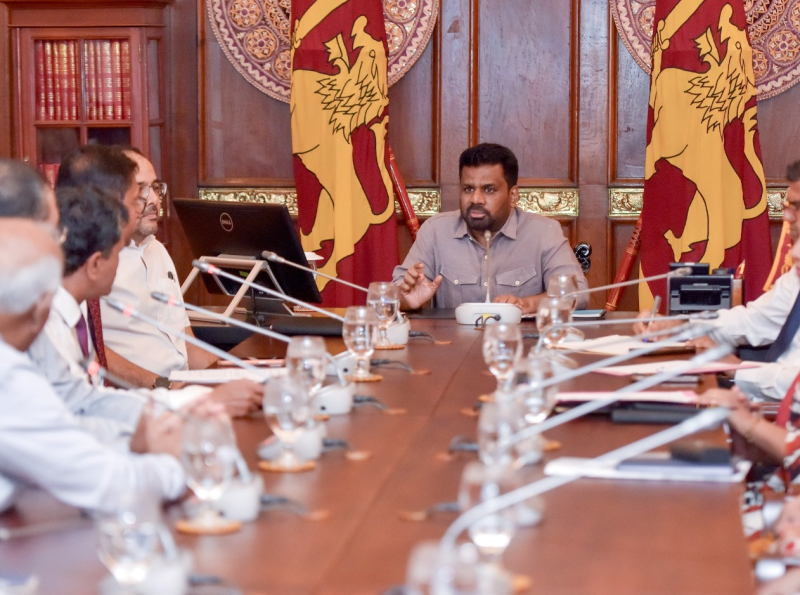
Government Will Provide All Necessary Support to Industrialists – President
President Anura Kumara Dissanayake stated that the Government's objective is to strengthen local industrialists and increase dollar earnings by guiding them towards export markets, adding that the Government will extend its fullest support to those who are prepared to invest and compete successfully in international markets.
The President made these remarks during a discussion held this morning (26) at the Presidential Secretariat with leading industrialists in the rubber and tea production and export sectors.
The President pointed out that many countries around the world have achieved economic strength by orienting their domestic industries towards exports, and emphasised that the only path to overcoming the existing burden of foreign debt and reducing dependence on international financial institutions is to enhance local production capacity.
Extensive discussions were held on new programmes that should be implemented to encourage local industrialists to enter the export sector. Attention was also focused on introducing a new strategic framework, in line with the National Export Development Plan 2026–2030, to revitalise the rubber and tea industries and increase export earnings.
Highlighting the importance of production capacity and reliable data, the President stressed the need for a clear understanding of annual production growth and output trends.
The President further noted that production processes must become simpler and more efficient, and requested that industrialists provide the Government with all relevant data necessary to identify and address the challenges faced by the sector.
He also emphasised that, particularly in the provision of fertiliser and other inputs, the relationship between such support measures and export earnings should be assessed on a scientific basis.
The President pointed out that efforts to encourage local industries should focus primarily on increasing net dollar earnings. He noted that the gap between the amount of foreign exchange spent on importing raw materials for exports and the amount earned through the export of finished products must be managed carefully. He further observed that it becomes problematic if substantial amounts of foreign exchange are spent on importing raw materials while the net export returns to the country remain inadequate.
It was revealed during the discussion that although the rubber sector has significant potential to generate foreign exchange for the country, current domestic production meets only around 50 per cent of national requirements.
Participants also discussed the potential to increase export earnings from the rubber industry by approximately USD 3 billion by 2030 through greater value addition.
It was noted that the principal obstacles to expanding rubber cultivation are limited land availability and labour shortages. As a possible solution, discussions were held on programmes to encourage low-income communities to participate in rubber cultivation.
Although Sri Lanka possesses a high capacity for tyre manufacturing, attention was also drawn to the adverse impact that tyre imports are having on the domestic industry.
The discussion further examined the inability of local industrialists to make their maximum contribution owing to shortages of raw materials and certain legal constraints, while possible solutions to these issues were also explored.
In addition to traditional rubber-growing regions such as Kalutara, Ratnapura and Kegalle, discussions focused on further expanding cultivation in areas such as Monaragala and Uva Wellassa. Increasing yields per hectare was also identified as a means of enhancing the incomes of rubber growers and encouraging them to remain engaged in the industry.
Attention was also given to expediting the implementation of new methods introduced by rubber research institutions so that they better align with industry requirements. Discussions further centred on promoting rubber cultivation through scientific approaches rather than converting rubber plantations to oil palm cultivation or other uses.
Tea exporters pointed out that the situation in the Middle East, particularly in relation to the Iranian market, has increased both the time and cost involved in tea exports.
Given that Iran remains a highly important market for Sri Lankan tea, a request was made for the Ministry of Foreign Affairs to intervene in resolving the financial issues surrounding the existing "Oil for Tea" barter arrangement between Sri Lanka and Iran.
The need to provide concessions for planting material and fertiliser to improve the productivity of more than 480,000 smallholder tea growers, who account for the majority of Sri Lanka's tea production, was also emphasised.
Lengthy discussions were held on delays in obtaining VAT refunds, one of the principal challenges faced by exporters. Attention was also focused on conducting training programmes jointly by the Ministry of Finance and the Inland Revenue Department to further educate exporters, facilitate their operations and help remove the related obstacles.
Expressing their appreciation for the opportunity to discuss the challenges facing their respective sectors directly with the President, the industrialists pledged their fullest support to the Government's efforts to strengthen the national economy.
Also present at the meeting were Secretary to the Ministry of Finance, Planning and Economic Development, Dr Harshana Suriyapperuma; Controller General of Imports and Exports, Upamali Premathilaka; Deputy Commissioner General J.M.S.S. Ratnawardhana; Commissioner S.A.P.D. Dissa Bandara; Director of Customs S.D. Abeysekera; Senior Deputy Director of Customs G.G. Senarathna; Chairman of the Export Development Board, Mangala Wijesinghe; President of the Tea Exporters Association, Huzefa Akbarally; as well as a number of leading business leaders and investors from the tea and rubber sectors.