
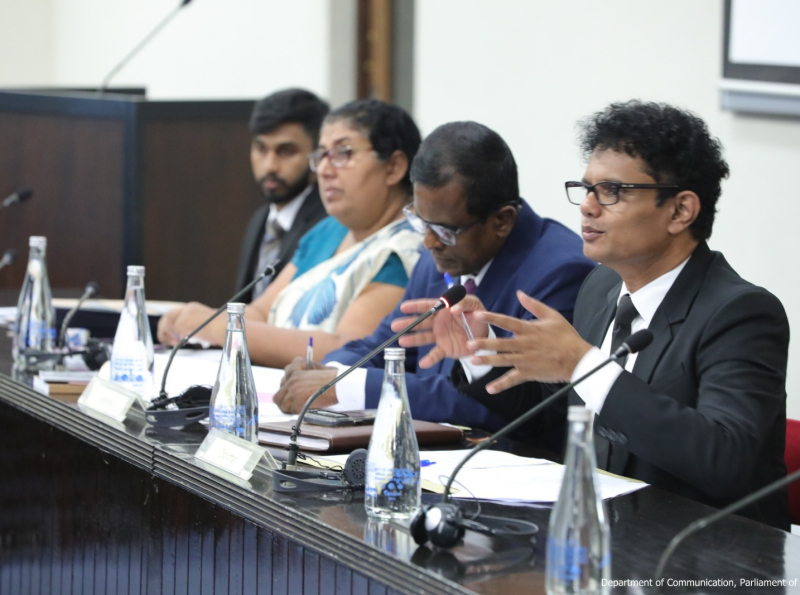
The Sectoral Oversight Committee on Education, Manpower and Human Capital has decided to appoint a Parliamentary subcommittee to study the salary disparities arising when teachers are appointed to the Principals’ Service, as well as the resulting reluctance among senior teachers to enter the Principals’ Service, and to make recommendations in this regard.
These matters were discussed when the Sectoral Oversight Committee on Education, Manpower and Human Capital met in Parliament recently, under the chairmanship of Member of Parliament, Attorney-at-Law Hesha Withanage. Particular attention was drawn to the salary disparity arising from the fact that, under the Sri Lanka Principals’ Service Minute issued on 22 October 2014, entry into the Principals’ Service from the Teachers’ Service is considered a “new appointment” rather than a “promotion.” Officials pointed out that this situation is further aggravated by the significant difference in salary increments when a teacher is appointed from Grade 1 of the Teachers’ Service to Grade III of the Principals’ Service.
They also noted that, although an adjustment allowance was introduced under Circular No. 03/2014 to address the salary difference arising at the time of appointment to the Principals’ Service, a salary gap emerges again as the teacher’s service progresses because they do not receive the higher salary increments that they would have received had they remained in the Teachers’ Service. It was also discussed that, as a result, senior and experienced teachers in Grades 1 and 2-I of the Teachers’ Service are being discouraged from sitting for the Principals’ Service examination and entering the Principals’ Service. Accordingly, attention was drawn to amending the Service Minute so that entry into the Principals’ Service from the Teachers’ Service would be treated as a “promotion” rather than a “new appointment.”
The procedure for granting promotions within the Teachers’ Service was also discussed. The Committee pointed out that a newly appointed teacher entering the service with a university qualification takes approximately 19 years of service to reach Grade 1 of the Teachers’ Service. Attention was also drawn to the direct recruitment of Bachelor of Education (B.Ed.) graduates to Grade 2 of the Teachers’ Service in accordance with the Teachers’ Service Minute. Meanwhile, it was revealed that a verbal agreement had been reached with the Public Service Commission to recruit B.Ed. graduates as teachers under the previous system until 2030.
Accordingly, it was stated that a Cabinet Memorandum has been submitted to recruit B.Ed. graduates to Grade 2 of the Teachers’ Service during this year. It was also discussed that these recruitments are planned to be carried out separately from the ongoing recruitment process for 23,000 teachers, based on subject-specific vacancies existing at provincial level. The Committee also considered the need to give universities until 2030 to update B.Ed. degree programmes so that they correspond with the actual subject requirements of the school system. In particular, the Committee highlighted the need to introduce specialised B.Ed. programmes in fields such as Science, Mathematics and Primary Education. Meanwhile, the Committee also considered the issue of recovering excess salary payments made to 261 laboratory attendants and security guards in the Southern Province.
It was revealed that approximately Rs. 50.8 million had been overpaid as a result of the employees being placed on the 12th salary step instead of the initial salary step of the relevant salary scale in 2008 and 2009. It was stated that the matter was identified in 2016 and was subsequently examined through an audit query in 2022. To date, Rs. 15.1 million has been recovered through the suspension of salary increments and deductions from salaries.
The representatives who appeared before the Committee pointed out that the employees were not directly responsible for this administrative error and that their letters of appointment had specified a particular salary scale. Accordingly, the Committee decided to bring the matter to the attention of the Governor of the Southern Province by way of a letter, with a view to obtaining his positive intervention regarding the difficulties faced by the employees.