
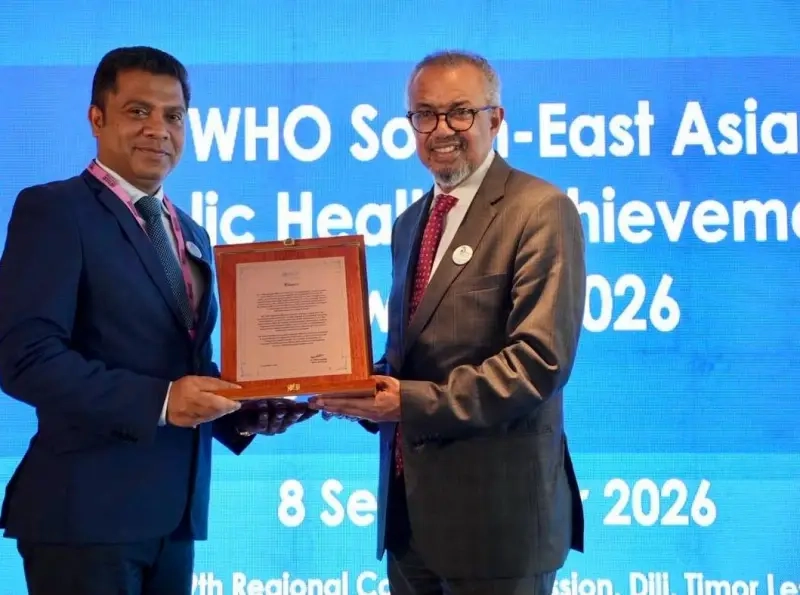
The World Health Organization (WHO) has presented a special official citation to Sri Lanka in recognition of two significant achievements in the country’s public health sector—sustaining malaria-free status and the elimination of maternal and neonatal tetanus for 10 consecutive years.
The citation was presented by WHO Director-General Dr. Tedros Adhanom Ghebreyesus to Minister of Health and Mass Media Dr. Nalinda Jayatissa during the 79th Session of the WHO Regional Committee for South-East Asia, currently being held in Dili, Timor-Leste. The citation, signed by Dr. Nilesh Buddha, Officer-in-Charge of the WHO South-East Asia Regional Office, recognises Sri Lanka’s continued success in maintaining these major public health achievements.
Sri Lanka was officially certified by the WHO as a malaria-free country in 2016. Since then, the country has successfully maintained its malaria-free status for a decade by preventing the reintroduction and spread of the disease.
Sri Lanka became the second country in the WHO South-East Asia Region, after the Maldives, to achieve malaria elimination. Its continued success has also contributed significantly to regional efforts to make South-East Asia a malaria-free region.
Sri Lanka has also successfully eliminated maternal and neonatal tetanus (MNT) and has maintained this achievement for 10 consecutive years. The country’s tetanus immunisation programme for pregnant women continues to be implemented nationwide at a high level.
According to the WHO, Sri Lanka’s strong and resilient primary healthcare system, sustained national commitment, high immunisation coverage, and effective disease surveillance and control systems have played a key role in achieving and maintaining these public health milestones.
The WHO further noted that these achievements go beyond health milestones, contributing to the protection of the lives of the Sri Lankan people and supporting the creation of a healthier future for generations to come.