
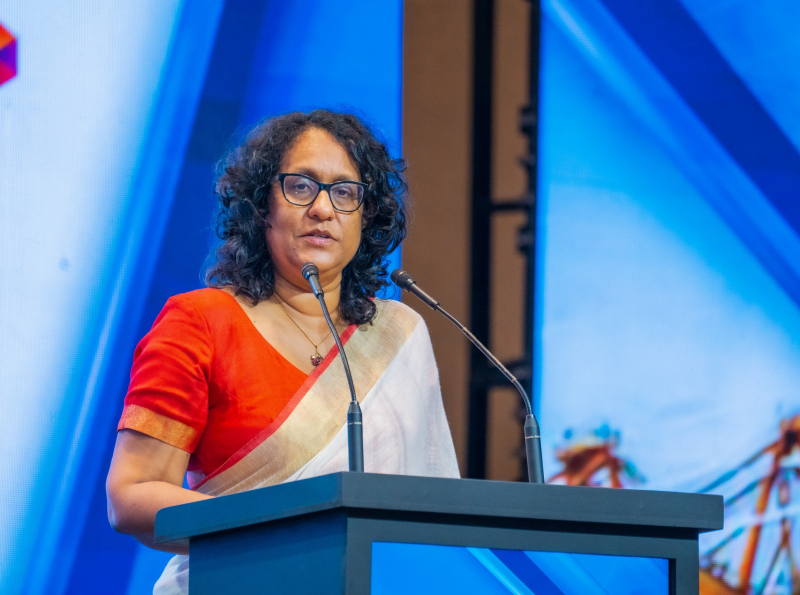
Prime Minister Dr. Harini Amarasuriya participated in the 26th edition of the Sri Lanka Economic and Investment Summit (SLEIS) 2026 on 13 October.
The summit, held on 12 and 13 October 2026, brought together policymakers, business leaders, investors, and other stakeholders to discuss Sri Lanka’s economic prospects and investment opportunities.
Addressing the session on “Nation Building in the Digital Age,” the Prime Minister highlighted the Government’s commitment to transforming Sri Lanka from a consumer of technology into a creator of innovation, with the ambition of expanding the digital economy to USD 15 billion by 2030, increasing digital exports to USD 5 billion, and developing a digital workforce of 200,000 professionals.
She highlighted the importance of Digital Public Infrastructure in modernising government institutions and improving public service delivery. The Government has committed approximately Rs. 30 billion towards foundational digital transformation initiatives through the institutional framework established under the Ministry of Digital Economy.
She cited GovPay, which has processed over Rs. 6 billion in payments with more than 300 organisations connected, as an example of how digital platforms can simplify government transactions, improve transparency, and reduce administrative burdens on citizens and businesses.
The Prime Minister also outlined the role of digital technology in transforming key sectors of the economy, including healthcare, agriculture, energy, and transport. She highlighted the potential of digital health systems and telemedicine to improve access to healthcare, data-driven agricultural practices to strengthen productivity and water management, and smart grids and digital energy management systems to support the transition towards renewable energy. She further noted that digital ticketing, real-time fleet tracking, and intelligent traffic management could improve transport efficiency and reduce the daily difficulties faced by commuters.
The Prime Minister stressed that vocational and technical education must be recognised as an equally valuable pathway to employment and professional advancement. She called for stronger partnerships between educational institutions and industry, opportunities for practical training, and the adoption of flexible qualifications, including micro-credentials, to respond to evolving labour market demands.
The Prime Minister also stressed that technology alone cannot eliminate inequality and that digital policies must remain citizen-centric. She noted that the success of digital transformation should be measured not simply by the number of platforms developed, but by whether public services, business operations, and everyday life become more accessible, efficient, and convenient for all citizens.
Participating in a panel discussion afterwards, the Prime Minister noted that while technology offers significant opportunities to transform education, the process must be carefully managed to ensure that existing inequalities are not further widened and that all students have equitable access to these opportunities.
The Prime Minister emphasised the importance of investing in digital infrastructure, expanding access to technology-enabled education, and introducing modern curricula that respond to evolving global demands. She also highlighted the need to approach the integration of artificial intelligence and other emerging technologies in education with caution, particularly regarding their potential implications for critical thinking, reasoning and cognitive development.
Referring to the Government’s ongoing efforts to address disparities in digital access, the Prime Minister stated that a five-year plan had been developed, in collaboration with the Ministry of Digital Economy, to strengthen digital readiness across the education system and ensure that more schools are equipped with the necessary infrastructure to benefit from technological advancements.
The Prime Minister further underscored that transforming education and preparing the workforce for the future cannot be achieved by the Government alone. Calling for stronger collaboration between the Government, private sector and industry, she encouraged businesses to support vocational education through industry placements, partnerships with vocational training institutions, and the development of programmes that reflect actual labour market needs.
The occasion was attended by Chairperson and the member of Ceylon Chamber of Commerce, Mr. Krishantha Balendra, the secret to the Ministry of Digital Economy, Mr. Watuna Sri Dhanapala, and government officials and industry representatives.