
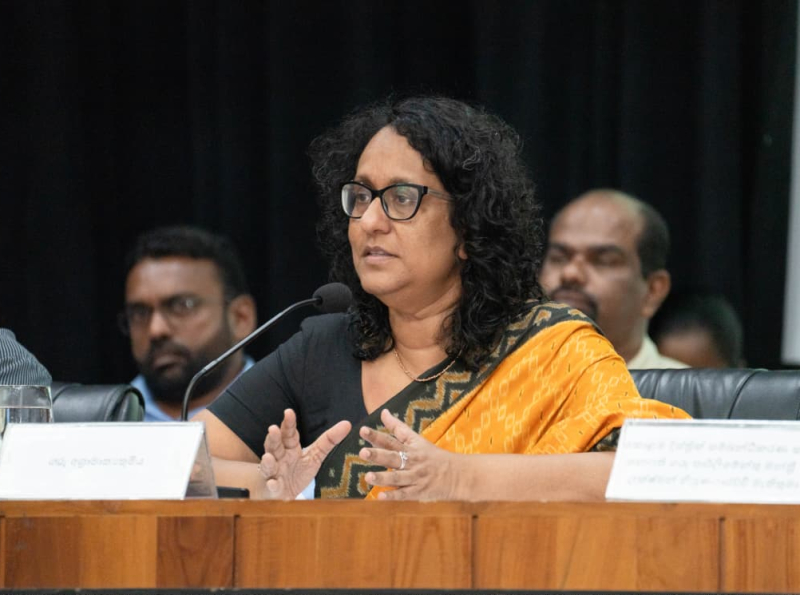
Prime Minister Dr. Harini Amarasuriya emphasised the importance of being prepared to face emergencies and unusual natural disasters arising from climate change, as well as taking measures to minimise the damage they may cause. She further stressed that disaster management requires an integrated approach involving multiple sectors rather than being confined to the responsibilities of a single sector.
The Prime Minister made these remarks on 10th of November at the Colombo District Coordinating Committee meeting held at the Official Residence in Narahenpita.
The meeting, held with the participation of the Prime Minister and chaired by Member of Parliament Lakshman Nipuna Arachchi, Chairman of the Coordinating Committee, focused special attention on the flash floods and disaster situation experienced in the Colombo District due to heavy rainfall on 6 November.
Addressing the meeting, the Prime Minister pointed out that, in the face of ongoing climate change, the country must be prepared not only to respond to such emergencies and unexpected natural conditions but also to minimise the potential damage they could cause. She also underscored the need for a coordinated approach to disaster management, involving different sectors rather than limiting responsibility to a single institution or sector.
The Prime Minister further noted that the Colombo District and the city of Colombo have distinctive geographical and urban characteristics. She pointed out that the flooding and inundation currently being experienced are the result of numerous issues that have remained unresolved for a long period.
She emphasised that these challenges must be addressed through a comprehensive programme encompassing waste management, proper waste disposal, the maintenance of waterways and the conservation of low-lying areas.
At the meeting, Colombo District Secretary Ginige Prasanna Janaka Kumara presented details of several major projects currently underway to control flooding and rainwater accumulation in the Colombo District.
These included a project, with an allocation exceeding Rs. 15,000 million, already initiated to control flooding in the Kolonnawa area alongside the Kelani River Basin Flood Control Project; a project launched at a cost of Rs. 450 million to clean and develop all waterways in Kaduwela; a project to clean and develop four major canals in Kolonnawa; and a project initiated by the Department of Irrigation to develop the riverbanks of the Kelani River.
The Prime Minister paid special attention to the details presented regarding these projects.
In addition to the ongoing projects, the Coordinating Committee discussed priority measures that should be implemented to minimise the risk of similar disasters occurring in the future.
During the discussion, the Prime Minister stressed that necessary and appropriate decisions must be taken without further delay to address longstanding problems that have become increasingly severe due to the failure to make timely decisions over the years.
She also pointed out that cleaning canals, drains and waterways should not be an activity undertaken only when a disaster occurs. Instead, it must be an ongoing process supported by regular maintenance.
The Prime Minister also paid special attention to the progress achieved so far in development programmes being implemented in the Colombo District, rural road development projects across the district, and the Praja Shakthi programme.
The meeting was attended by Deputy Speaker of Parliament Dr. Rizvie Salih, Western Province Governor Hanif Yusoof, Deputy Minister of Defence, Retired Major General Aruna Jayasekara, Deputy Minister of Urban Development Eranga Gunasekara, Members of Parliament representing the Colombo District, chairpersons of local government authorities, and a number of government officials from the Colombo District, including Western Province Chief Secretary Pradeep Pushpakumara.