
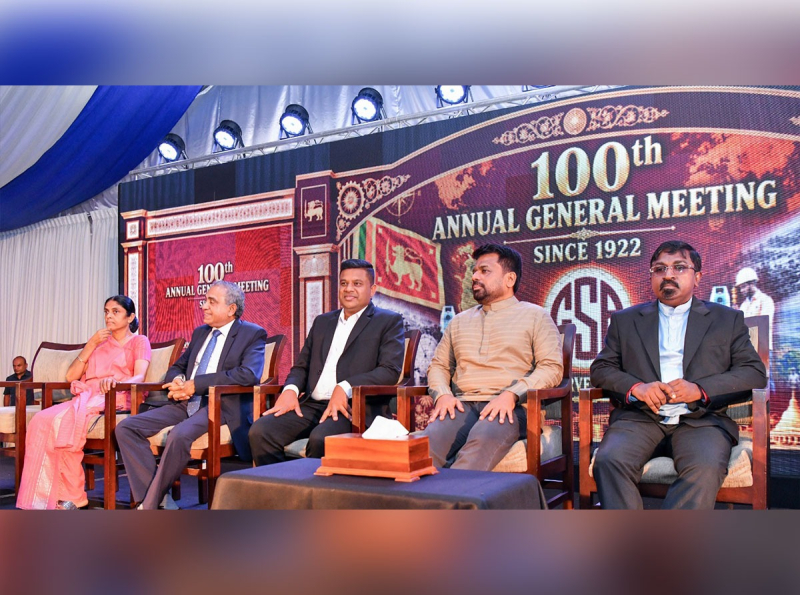
President Anura Kumara Dissanayake stated that the Government is prepared to provide the necessary facilities to establish an efficient surveying service equipped with modern technology, noting that such a service is essential to achieving national development objectives.
The President made these remarks while attending the 100th Annual Conference of the Government Surveyors’ Association, held at the Waters Edge Hotel in Battaramulla this morning (23).
The President commended the Survey Department, one of the oldest departments in Sri Lanka’s public administration, and the centenary-old Government Surveyors’ Association for their distinguished contributions to the country’s development while upholding professional dignity and service standards throughout their proud history.
The Government Surveyors’ Association is committed to promoting technological advancement, professional development and knowledge-sharing; recognising the contributions of previous generations of surveyors; preparing the next generation to meet future challenges; and continuing to contribute to national development through accurate and reliable surveying services.
A commemorative gift was presented to the President to mark his participation in the association’s 100th Annual Conference.
Addressing the gathering further, President Anura Kumara Dissanayake said:
“We are making a tremendous effort to bring our economy to a very stable position and ensure that the benefits derived from it reach the people. We have been able to strengthen government revenue considerably. For the first time in Sri Lanka’s history, revenue collection in 2025 reached 110% of the projected target. Previously, no budget had achieved its projected revenue targets, with actual collections remaining well below them.
In 2026, too, we will be able to achieve a very healthy level of revenue by meeting the targets set for the main revenue-generating institutions: the Department of Inland Revenue, the Sri Lanka Customs Department and the Department of Excise.
Because the Government lacked funds, it was constantly compelled to print money or borrow from the banking system. In 2022, the Treasury account stood at a deficit of approximately Rs. 700 billion. Today, however, it has a positive surplus approaching Rs. 1 trillion. This has helped us considerably resolve the rupee crisis we faced.
The inability to earn the dollars the country needed was one of the causes of the crisis. In 2025, the current account balance, the difference between the dollars flowing into and out of the country, reached a significant level. Since independence, Sri Lanka has recorded a current account surplus on only about three occasions, and those surpluses were approximately US$300 million. In 2025, however, our current account surplus rose to US$1.8 billion.
Nevertheless, the conflict in the Middle East has exposed us to an unexpected impact. Last year, we spent US$4 billion on oil imports, and by the end of August this year, we had already spent US$4 billion. Since US$4 billion was spent in just two-thirds of the year, the total could exceed US$6 billion by year-end. Managing the pressure on our foreign exchange reserves is therefore one of the main challenges we face.
We have launched a large number of major projects using domestic Treasury funds alone, without borrowing in dollars. These include the Kurunegala–Galewela Expressway, the Rambukkana–Galagedara Expressway and the Kahathuduwa–Ingiriya Expressway. We also plan to commence next year, using Treasury funds, the estimated Rs. 600 billion project to electrify the Kelani Valley railway line.
However, even when expenditure is in rupees, dollars are required to import the machinery, steel and other materials needed for expressway construction. We plan to increase capital expenditure from Rs. 1,330 billion this year to Rs. 2,000 billion (Rs. 2 trillion) next year. As higher capital expenditure increases pressure on foreign exchange, earning dollars and minimising dollar outflows must be our principal economic strategies.
Although we now have sufficient rupee resources to withstand domestic shocks, our economy is not yet strong enough to withstand external shocks arising from factors such as tourism, foreign workers’ remittances and fuel prices. Our plan is to build an economy resilient to external shocks.
The wealth accumulated in the Treasury must reach people at the grassroots level, improving public services and addressing land-related issues while providing agricultural, educational and healthcare facilities. This responsibility should be fulfilled by a strong state machinery rather than the political authority. Without a strong public administration, wealth cannot be channelled down to the people.
Although public sector employment was highly sought after in the past, the inability to retain professionals has diminished its attractiveness. As a result, recruiting engineers, IT professionals and managers has become difficult.
To address this issue, the 2025 Budget provided for an increase in the basic salaries of public sector employees, to be implemented in three phases in 2025, 2026 and 2027. Each phase will cost Rs. 110 billion. By 2027, compared with 2024, the Government will have to bear an additional salary burden of Rs. 330 billion.
As no further increase in basic salaries is planned in the 2028 Budget, greater consideration can be given to allowances at that stage. Nevertheless, the current Budget has also taken care to provide essential allowances.
We need a surveying service equipped with highly modern technology. If an assessment study is submitted identifying the modern technological equipment required by the surveying service, we are prepared to allocate the necessary funds in the Budget. We are also giving attention to resolving issues relating to human resource development and allowances.
As the requirements today differ from those that existed 20 years ago, we will also consider conducting a study and making the necessary amendments to the service minute.
Political appointments made in the past have resulted in excessive staffing at lower levels of the public service, creating a substantial financial burden. Accordingly, the Ministry of Finance has appointed a committee to consider closing or amalgamating 34 institutions deemed unnecessary or inefficient. Our aim is to build an attractive public service comprising capable and highly qualified professionals.”
Deputy Minister of Land and Irrigation Aravinda Senarath, Member of Parliament Ruwan Thilaka Jayakody, Secretary to the Ministry of Agriculture, Livestock, Land and Irrigation D. P. Wickramasinghe, Surveyor General T. M. I. Thilakarathna, and members of the Government Surveyors’ Association were also present at the occasion.