
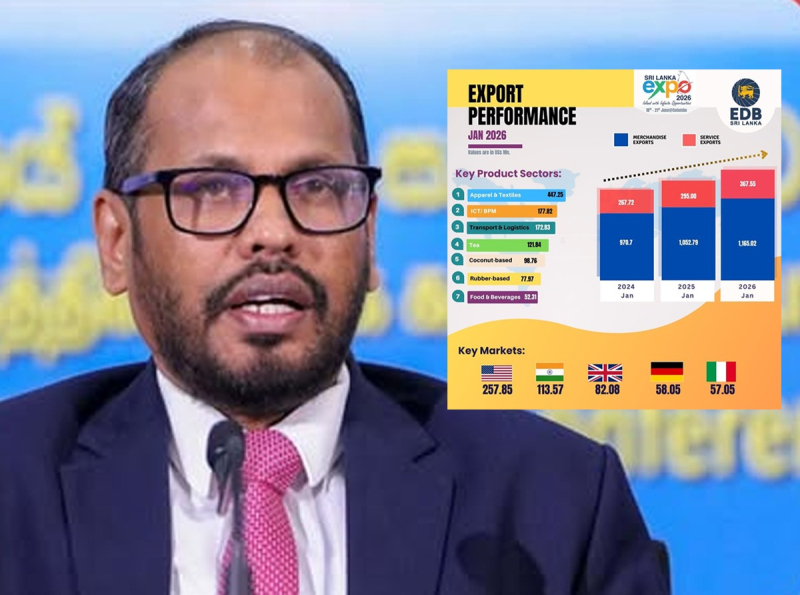
Sri Lanka’s export sector has recorded a robust growth of 13.71 percent at the beginning of 2026 compared to the previous year, signaling a renewed momentum in the country’s foreign trade sector, said Mangala Wijesinghe, Chairman of the Sri Lanka Export Development Board.
He made these remarks while addressing a media briefing held at the Government Information Department today (24).
According to estimated data from Sri Lanka Customs, total export earnings from gems and jewellery, petroleum products, and services exports have increased to US$ 1,532.6 million. Merchandise exports in January 2026 grew by 10.66 percent year-on-year to reach US$ 1,165.02 million, while service export earnings saw a significant increase of 24.59 percent, amounting to US$ 367.55 million.
Wijesinghe noted that the earnings recorded in January mark a strong beginning towards achieving the annual export targets. He emphasized that the growth reflects improving competitiveness in Sri Lanka’s export sector, supported by the gradual recovery of international markets, sustained industrial capacity, and strategic export development initiatives.
He further highlighted that the services sector—including ICT/BPM, construction, financial services, and transport and logistics—will continue to play a vital role in diversifying exports and creating high-value employment opportunities across the island.
Expressing confidence in maintaining this positive momentum throughout 2026, he stressed the importance of continued policy support and market diversification efforts.
Meanwhile, he announced that Expo 2026 will be held from June 18 to 21 at the Bandaranaike Memorial International Conference Hall after a lapse of 14 years. The exhibition is expected to attract leading international buyers and will thereafter be organized biennially. A major investment forum is also scheduled for July.
The Chairman added that several strategic programs have been launched to achieve export targets within the next five years. He also pointed out the advantages of duty-free access to the United States market and efforts to attract Japanese manufacturers to set up operations in Sri Lanka, enabling exports to India, Africa, the Middle East, and European markets.