
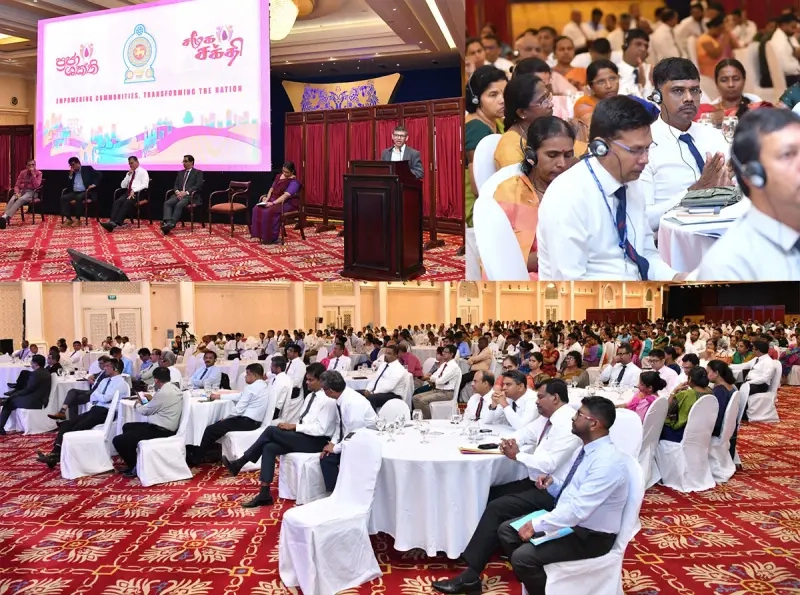
A programme to brief District Secretaries, Divisional Secretaries and District Planning Directors on the next steps of the Prajashakthi National Movement was held recently (24) at Temple Trees under the leadership of Secretary to the President Dr Nandika Sanath Kumanayake.
Addressing the gathering, Dr Kumanayake emphasised that proper coordination among officials was essential in carrying out all development activities, including those under the Prajashakthi programme. He also stressed that any issues obstructing development should be resolved systematically.
He pointed out that public officials needed to cultivate certain qualities within themselves and that development work could be facilitated by working efficiently and as a team.
He also explained the importance of developing personally as an official who acts without corruption.
Speaking further, Dr Nandika Sanath Kumanayake said:
One of the prominent demands that emerged during the ‘aragalaya’ amid the recent economic crisis was that corrupt politicians should be removed. The issue of public servants also being responsible emerged alongside that demand. At the last election, the people had the opportunity to send corrupt politicians home and bring a new force to power. However, they cannot transfer public officials or send them home. There is no mechanism for that. When people visit a government institution to obtain a service and experience irregularities, injustice or wrongdoing, there must be a place where they can report it. That is why we established Internal Affairs Units in government institutions.
What is corruption? Even among public servants, there is no clear understanding of this. If an official uses the authority entrusted to them to perform their duties in any way for their personal benefit that is corruption. If such practices are not addressed at the outset, and if they are followed by those at the top, they become the normal way of doing things. That was the system that existed in our country. “Why should we reject such practices? Ultimately, they can lead to an economic crisis. Investors become reluctant to come to the country. Essential projects were not implemented, while unnecessary projects were undertaken. As a result, the country accumulated debt and eventually reached a point where it did not have sufficient foreign exchange to import fuel. Taxes were imposed at levels the public could not bear, and poverty increased. Corruption was the reason for this. These practices also destroy human relationships and lead to an increase in crime. They have now spread even into the private sector. As a result, our country fell to one of the lowest positions in the world in terms of preventing corruption.
People had no place to report these matters. They were concerned about what would happen to their safety if they spoke out. Therefore, no one revealed what they knew. Eventually, these issues erupt somewhere, and the ‘Aragalaya’ were one such occasion. We need to encourage people to come forward and report these matters. Through this, we expect to strengthen integrity among public servants. Internal Affairs Units were established in government institutions for this purpose. Report any wrongdoing or injustice you experience to these units. We will intervene.
Senior Additional Secretary to the President Kapila Janaka Bandara briefed the gathering on five areas: the rural road development database planned for 2027, the introduction of an Innovation Hub, the preparation of a strategic plan, the collection of data for an online information system relating to tanks and the ellangā cascade irrigation system, and the introduction of an entrepreneurship development database.
Speaking further, Mr Kapila Janaka Bandara said:
Our expectation is to make the Prajashakthi programme the central hub of community and rural development. At present, data and information are its most important elements. Empires around the world have collapsed because of the lack of proper data and information. Therefore, one of the main objectives of the Prajashakthi Secretariat is to build a national development database. We are carrying out the preliminary work for this purpose. This database has been developed while seeking solutions to the challenges identified.
We have already introduced around four data systems. Next year, we will develop an information system targeting rural-level development. One of these systems will cover rural roads. The Road Development Authority had around 10,000 roads under its purview. We intend to develop and implement an information system covering all roads below that level as well. The Prajashakthi Secretariat and the Ministry of Public Administration have submitted two proposals for this purpose. Funding has been confirmed for 2027. If we complete the necessary preparations by December, we will be able to commence the work in January.
Through this database, proposals submitted by communities can be referred to the relevant institutions and development work can be carried out. Information relating to the work will also be added to the database. This will make it possible to access all relevant information about the development of a particular road at any given time.
We are now living in a period of climate change. In the face of climatic variations involving severe droughts and heavy rainfall, we must manage our water resources properly to meet the needs of the public for drinking water, agriculture, other industries and electricity generation.
We also intend to implement a three-year development plan targeting individual villages, extending below the Divisional Secretariat level. We are currently preparing the national strategic plan for this purpose. This is a technically challenging task. As the Prajashakthi Secretariat, we expect to obtain the support of the university system. We will not limit ourselves to universities. We will also work with other organisations and institutions that possess the necessary knowledge, skills, technology and information, including private institutions, voluntary organisations and government institutions, to develop an integrated programme.
Our fundamental concept is that, once the community identifies its development needs, the potential for development should be identified by the relevant multidisciplinary teams and implemented through the Prajashakthi Movement.
Secretary to the Ministry of Public Administration, Provincial Councils and Local Government Aloka Bandara said:
During the pre-budget discussions, the President raised the question of how District and Divisional Secretariats could be further developed into central institutions for directing development activities.
Under the previous structure, proposals were submitted through Divisional Secretariats, Divisional Coordination Committees and planning divisions, and were implemented through District Planning Directors and District Coordination Committees. A further structure has now been introduced below this level. The project proposals and plans emerging from it have potential beyond rural development alone and could be transformed into programmes at divisional, district, provincial or national level.
Although Rural Development Councils submit proposals limited to their respective geographical areas, these proposals may have wider potential. The responsibility for identifying that potential and transforming the proposals into national-level programmes rests with Divisional Secretariats, District Secretariats, Provincial Councils and national-level institutions. The groups submitting proposals are keen to see them implemented and to obtain results in their villages. Therefore, there is a need to include and implement initiatives that can deliver results quickly. If implementation takes a long time and continues within the same traditional framework, public confidence in this movement may decline. Furthermore, as this structure is developed, we must recognise that it involves people. Differences in their thinking, interpersonal relationships and knowledge at village, divisional and district levels may lead to misunderstandings and conflicts during implementation. These issues must be resolved maturely by a team with experience in administration and planning.
A structure extending to the national level is available to resolve such issues, and it must be used. It is important to discuss the problems that have emerged during the first year and determine the way forward. Traditionally, development programmes have been confined to 31 December. However, we must also consider structural changes that would allow activities to be approved and implemented even in the middle of the year.
Community Development Councils should be briefed once or twice a year on programmes planned at national level. Members of these councils should work with a national perspective rather than focusing only on their immediate experiences, such as the construction of a village road. “The potential of proposals submitted by these councils should be discussed at national level, and communities should be kept informed when future projects, investments or grants become available. The Government’s vision is to improve living standards within villages rather than bringing people from villages into towns. Therefore, it is important for officials serving on Community Development Councils to work with a broader vision that extends beyond their own villages.
All necessary facilities have been provided to public officials, and we expect their fullest support. There appears to be a tendency among some officials to avoid their professional responsibilities by engaging in trade union action based on unfounded slogans and unjustified demands. If we are to develop the country, officials must pay particular attention to fulfilling the duties assigned to them.
Secretary to the Ministry of Rural Development, Social Security and Community Empowerment Sampath Manthrinayake also spoke about the implementation of the Prajashakthi National Programme in 2026. Senior Additional Secretary to the President H.M.K.J.B. Gunaratne addressed the planned future activities under the programme.
Additional Secretaries from various divisions of the Presidential Secretariat also briefed officials on several matters. These included the ‘Aththama’ programme under the Clean Sri Lanka initiative, relief for people affected by Cyclone Ditwah in accordance with circulars issued by the Ministry of Finance, Planning and Economic Development; and the Litigation Management System introduced by the Legal Division of the Presidential Secretariat.
Members of the Executive Council of the Prajashakthi National Programme, District Secretaries, Divisional Secretaries, District Planning Directors and other government officials attended the programme.